
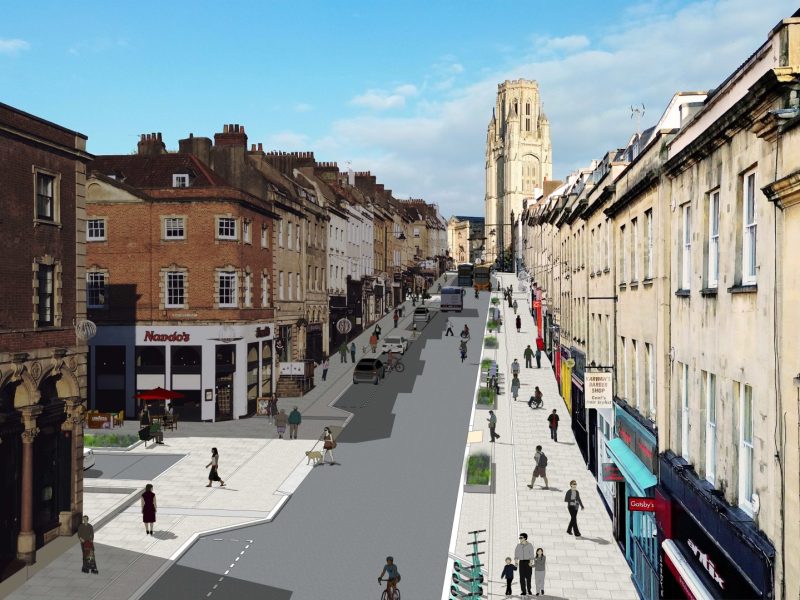
A PLANNED £15m scheme to ban through traffic from Park Street has been blocked.
The proposal from the Green-led administration at Bristol City Council was defeated at the transport policy committee last month.
Three Labour councillors, one Conservative and a Liberal Democrat outvoted the four Green councillors.
The opponents were concerned about an increase in pollution if drivers had to use the alternative route past the Bristol Royal Infirmary and the Children’s Hospital.
But their decision means thousands of bus passengers will continue to endure delays.
The meeting heard that about 35 buses travel along Park Street every hour in either direction. There are often queues along the entire street as buses and cars attempt to get into the city centre, holding up passengers for at least 10 minutes and impacting the reliability of the bus network city-wide.
A recent council traffic count on Park Streetr found that between 7am and 7pm, about 7,000 cars, 20,000 pedestrians and cyclists, and at least 30,000 bus passengers used the route.
Councillor Tom Renhard, leader of the Labour group, said: “The impact on air quality outside the hospitals is not something that I feel is a fair sacrifice in order to progress this scheme. It will go up by the amount it will reduce in the Colston Avenue area. It’s unfortunate that when WECA [the West of England Combined Authority] offered a compromise, it wasn’t taken.
“While you are going to get some modal shift, some people do need to use their cars to get about the city. That could be for a range of reasons, in my case caring responsibilities. I’m fully committed to looking at what we can do to get air pollution down. I’m not going to sign off on measures that are going to make air pollution worse outside our city’s hospitals.”
Council staff said the increase of air pollution along Park Row, Perry Road, Upper Maudlin Street and Marlborough Street — the road from the Bearpit to the Triangle thatr passes the hospical— would be negligible. Levels of nitrogen dioxide have been falling since the Clean Air Zone was brought in and would remain below legal limits if the plan went ahead.
Meanwhile levels of nitrogen dioxide would fall on probably the most polluted part of Bristol, around Colston Avenue, Lewins Mead and Rupert Street — the busy roads in between the Centre and the Bearpit. At the last annual count, pollution here is above the legal limit of 40 micrograms per cubic metre of air.
The Park Street ban would divert a lot of traffic from using this route, with pollution soon falling below legal limits.
Councillors were told that changes would be made to the Park Row alternative route, including to traffic light signals and removing islands, to cut down on congestion. But they remained unconvinced, and Labour suggested that the Clean Air Zone funding be used instead to pay for more subsidised bus routes. This cash has previously paid for new routes and existing routes to run more frequently.
Labour said this money could also be spent on repainting road markings, unblocking drains and installing better lighting on pavements. They suggested expanding a financial assistance scheme helping drivers upgrade to cleaner vehicles, and questioned the loss of parking income if some spaces were removed from Park Street.
The Park Street plan was first suggested by the former Labour mayor of Bristol, Marvin Rees, but the idea was later canned. Then the Greens revived the scheme, splitting public opinion. Some local businesses feared a loss of trade while walking campaigners said footfall would probably increase.
But the Labour mayor of the West of England, Helen Godwin, refused to fund the plan. Instead she offered a trial of a through-traffic ban just at peak hours. Because this would only cut traffic and pollution by about a third, the Greens rejected the trial and tried to pay for the scheme a different way.
Around £8 million would come from the Clean Air Zone income, and £5.3 million from a government air quality grant. However they needed the approval of the transport policy committee. Conservatives and Liberal Democrats previously opposed the plan, so the decision rested on the three Labour councillors, who last year abstained from a decision on Park Street.
Green Cllr Rob Bryher said: “Labour seem desperate to block a fully funded, deliverable scheme that will clean up air, give buses priority, reduce traffic congestion overall, create a better environment for shopping and dwelling, and reinvent the public realm up to the Triangle. We want to make the air safe to breathe for thousands of Bristol residents and visitors.
“It’s clear that Labour will only support schemes like this when they get to deliver them, not when the Greens — following on from Labour and Marvin’s good work setting up the Clean Air Zone — are delivering them. We thought there was a progressive consensus around clean air and bus priority.
“Labour have sadly broken that consensus by not seizing this opportunity to make our air clean enough to be legally compliant.
By Alex Seabrook, Local Democracy Reporting Service